

Guide · Exterior painting
When is the best time to paint a house in Wisconsin?
For most exterior paint, June through August, with September next. Those are the months when nights here usually stay above 50°F.
- Bonded & insured
- Free, no-pressure estimates
- Written warranty up to 10 years
Short answer
The short answer
Exterior paint cares less about the afternoon than about the night that follows. Standard latex house paint needs 50°F or warmer, and Sherwin-Williams advises keeping the temperature in range and above the dew point for about 48 hours after each coat. In Milwaukee and Waukesha counties, the NOAA 1991–2020 climate normals show that June, July and August are the months when nights reliably clear 50°F: on average, between 0 and about 8 nights a month fall to 50°F or below at the eight weather stations in this guide. September comes next, with 7 to 15 such nights.
May and October are different. On average, 21 to 28 nights in each of those months drop to 50°F or lower, so standard latex is out on most of them. Paint lines labelled for application down to 35°F can still work then, on days when the forecast holds, with earlier stopping times. In November, 14 to 22 nights a month reach 32°F or colder, below even that 35°F rating, and exterior painting waits for spring.
Written by Modern Painters LLC. Last reviewed 18 October 2026. Sources are listed at the end.
Nights at or below 50°F, by month
- April: too cold for most paint; 6 to 14 nights reach freezing
- May: 21 to 24 nights
- June: 3 to 8 nights
- July: 0 to 2 nights
- August: 0 to 3 nights
- September: 7 to 15 nights
- October: 24 to 28 nights
- November: 14 to 22 nights reach freezing
What the paint needs
How cold is too cold to paint outside?
It depends on the product, and the label on the can is the rule that counts. Sherwin-Williams gives 50°F as the normal minimum for latex house paint and says some of its exterior lines can be applied, and will cure, down to 35°F. For traditional latex it goes further: such paints need temperatures above 60°F to cure properly, which is why it calls spring and fall tricky. Benjamin Moore recommends planning projects for 35°F to 100°F with humidity as low as possible, and says each of its products has its own range on the label and technical data sheet.
Three details matter as much as the number. The temperatures on a label refer to the air, the surface and the paint itself, so a can left overnight in a cold truck or garage starts the day too cold. The range has to hold for about 48 hours after application, not only while the brush is moving. And the surface has to be dry and warmer than the dew point: Benjamin Moore puts the industry standard at more than 5°F above it.
When paint goes on too cold, or gets damp before its film forms, both manufacturers describe the same failures: slow drying, a latex film that never forms properly, peeling and poor adhesion. Sherwin-Williams adds surface staining as ingredients rise to the surface (surfactant leaching), mildew, and “frosting”, a whitish cast on dark colors. Our guide on paint peeling after winter covers how to tell a cold-weather failure from a moisture problem.
The manufacturers’ checklist
- The product label sets the minimum and maximum
- Air, surface and paint all inside that range
- A dry surface, above the dew point
- Conditions that hold for about 48 hours after each coat (Sherwin-Williams)
- No painting in rain; stop if it starts (Benjamin Moore)
The data
When the cold nights end and return, station by station
NOAA’s 1991–2020 climate normals give, for each weather station, the date by which the last spring night of 36°F or colder has happened in half of years, and the date by which the first fall one has arrived. We use 36°F because it is the closest threshold NOAA publishes to the 35°F minimum on low-temperature paint. The 32°F freeze dates are in the last column for comparison.
Read the dates as a coin toss: in half of years the last 36°F night of spring comes after the date shown, and in half of years the first one of fall comes before it.
| Station | 36°F-free window | Days | Freeze-free window (32°F) |
|---|---|---|---|
| Milwaukee Mitchell Airport | May 1 – Oct 18 | 168 | Apr 19 – Oct 29 |
| South Milwaukee WWTP | May 5 – Oct 16 | 162 | Apr 22 – Oct 26 |
| West Allis | May 8 – Oct 10 | 156 | Apr 26 – Oct 22 |
| Mt Mary College | May 8 – Oct 6 | 150 | Apr 26 – Oct 18 |
| Brookfield WWTP | May 10 – Oct 3 | 142 | Apr 30 – Oct 14 |
| Oconomowoc WWTP | May 12 – Oct 2 | 142 | Apr 30 – Oct 12 |
| Waukesha WWTP | May 13 – Oct 2 | 141 | May 1 – Oct 13 |
| Hales Corners / Whitnall Park | May 14 – Oct 3 | 141 | May 3 – Oct 14 |
Three things stand out. First, the spread: the 36°F-free window runs 168 days at Mitchell Airport and 141 to 142 days at the three Waukesha County stations and Hales Corners, nearly four weeks less. Second, the two longest windows belong to the two stations farthest east, nearest Lake Michigan: Mitchell Airport and South Milwaukee. The data shows that pattern; it does not tell you how one street or yard behaves. Third, the window for low-temperature paint is 21 to 24 days shorter than the freeze-free season at every station, and in fall the median first 36°F night comes 10 to 12 days before the median first freeze. Waiting for frost before you stop is too late.
Use the station closest to your house as the guide; none of them describes a single yard, and any one year can run warmer or colder than the 30-year normal. Some of our town pages do that for one place. Greenfield sits between Hales Corners and West Allis, whose dates differ by about a week at each end of the season (Greenfield’s two stations). Hartland sits at similar distances from the Waukesha, Oconomowoc and Brookfield stations, which agree within a few days (Hartland’s season). And Oconomowoc has a station of its own, less than a mile from the city’s center (Oconomowoc’s month-by-month lows), as does West Allis, about 1.6 miles from its center (West Allis’s own station). Mitchell Airport, the longest window in the table, is about 3 miles from the Pryor Avenue well in Bay View (Bay View’s lakeside season). Elm Grove lies between Mt Mary College, about 3½ miles to its east-northeast, and Brookfield WWTP, about 4½ miles west, whose 36°F dates differ by two or three days at each end of the season (Elm Grove’s two stations).
North of the county line the window is shorter still. At Germantown, one of the two stations nearest Mequon with temperature normals, the 36°F-free window runs from May 19 to September 29, a 132-day median, shorter than at any station in this table (Mequon’s painting season). Menomonee Falls lies between Germantown, about 5½ miles to its north, and Mt Mary College, about 7½ miles to its southeast, whose median windows differ by 18 days, 132 against 150 (the range for Menomonee Falls).
NOAA flags five of these stations (South Milwaukee, West Allis, Brookfield, Waukesha and Hales Corners) as “representative”: at least 10 years of data inside 1991–2020, with missing months estimated from surrounding stations. Mitchell Airport, Mt Mary College and Oconomowoc meet the “standard” 24-year test. The Hales Corners dates rest on 10 years. Three nearby NOAA stations to the north (Grafton, Port Washington, Germantown) are left out to keep the tables to Milwaukee and Waukesha counties; Milwaukee-Timmerman has no temperature normals.
Spring and fall
Why May and October are marginal
This table counts the nights each month when the low reaches 50°F or less, the nights that rule out standard latex. They are 30-year averages, so a given year can be warmer or colder.
| Station | May | Jun | Sep | Oct |
|---|---|---|---|---|
| Milwaukee Mitchell Airport | 22.3 | 5.1 | 7.6 | 24.3 |
| South Milwaukee WWTP | 22.8 | 3.4 | 7.0 | 23.7 |
| West Allis | 22.3 | 5.0 | 10.2 | 26.8 |
| Mt Mary College | 21.2 | 4.9 | 11.0 | 25.6 |
| Brookfield WWTP | 21.1 | 5.8 | 12.3 | 26.3 |
| Oconomowoc WWTP | 20.8 | 5.6 | 13.6 | 27.0 |
| Waukesha WWTP | 22.5 | 6.3 | 14.3 | 26.7 |
| Hales Corners / Whitnall Park | 24.0 | 8.1 | 15.2 | 28.2 |
In May and October, two nights in three or more fall to 50°F or below at every station: 21 to 28 of 31. Normal October lows run from 44.7°F at Mitchell Airport down to 39.7–40.2°F at Hales Corners, Waukesha, Oconomowoc and Brookfield; normal May lows are 45.5–47.8°F across all eight. Both sit below the 50°F latex minimum, and close enough to 35°F that a low-temperature paint still needs the forecast to cooperate.
June is the cleaner start, with 3 to 8 nights at or below 50°F. July and August are the steadiest months, at 0 to 2 and 0 to 3. September has 7 to 15, more than June at every station.
Dew
Dew and the short fall painting day
A warm fall afternoon can hide the real problem. Sherwin-Williams describes the common mistake: painting when the afternoon is comfortably warm and the night turns much cooler, because dew settles on almost everything once the sun goes down. Paint that was fine when it went on can stop forming its film, moisture gets into it, and the result can be surface staining and poor adhesion.
NOAA’s hourly normals for Milwaukee Mitchell Airport, the station in this guide we have hourly data for, show how thin the margin is. In September and October, the normal air temperature in the 7 a.m. hour (standard time) is only about 7°F above the normal dew point; by mid-afternoon the gap is about 16°F. In May the morning gap is about 10°F. Benjamin Moore’s standard is a surface more than 5°F above the dew point, and it notes that a surface can sit at a different temperature from the air around it. These gaps are our arithmetic on two NOAA averages at one airport, so read them as a regional picture, not a forecast.
In practice, the fall painting day is short at both ends. The start waits until dew has gone and the surface is dry; the finish has to come early enough for the paint to dry before evening moisture arrives. Sherwin-Williams says most products need at least 4 hours of dry time before moisture settles on them, and that the cooler it gets, the sooner you should stop.
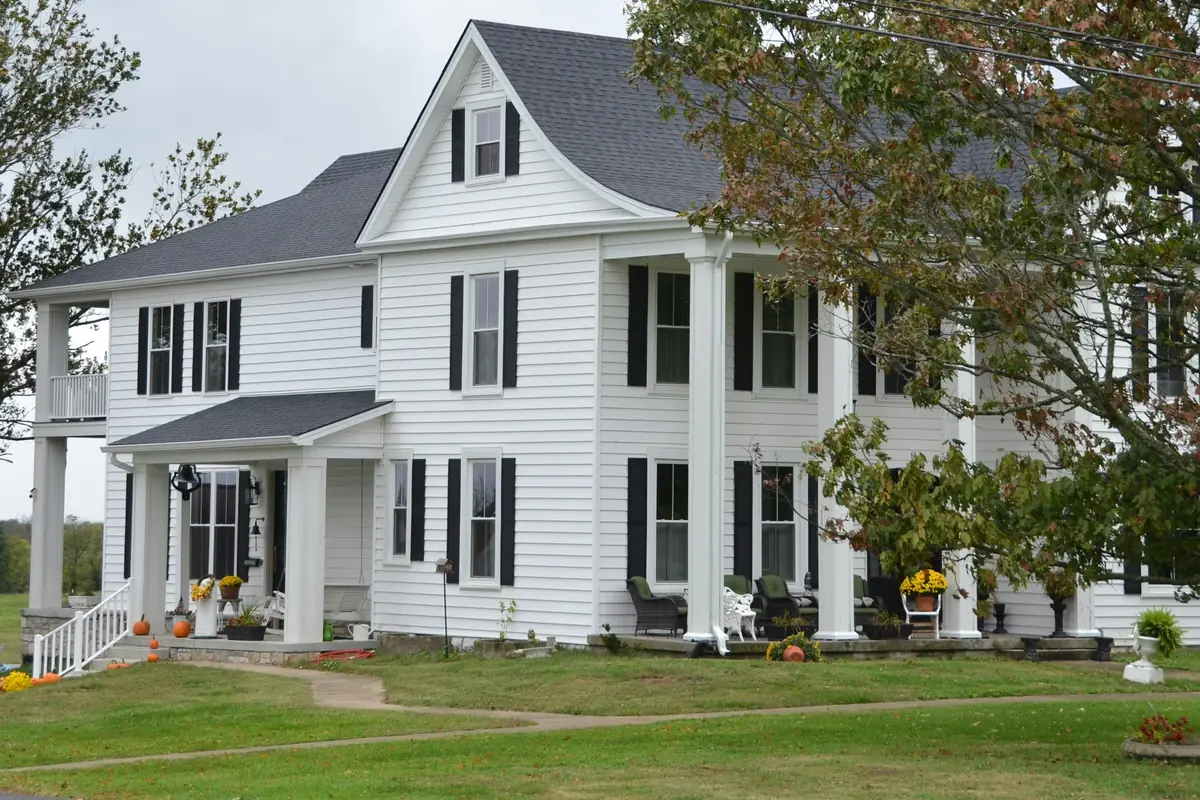
Painting in a Wisconsin fall
Is October too late to paint a house in Wisconsin?
Not automatically, but in October the product and the forecast decide, not the calendar. With standard latex, most October nights are already too cold at every station in this guide. With a paint labelled for 35°F, early October is often workable: the median first 36°F night falls between October 2 (Waukesha and Oconomowoc) and October 18 (Mitchell Airport). After that, cold nights become routine. On average, 11 to 19 October nights reach 40°F or lower, and 2 to 9 reach freezing.
Before an exterior coat goes on in fall, everything on this list should be true. If one item is not, the honest choice is to wait for a better stretch, or for spring.
Fall go/no-go check
- The paint is rated for the conditions: 50°F for standard latex, 35°F for some lines
- Forecast lows for the next two nights stay above that minimum
- Siding and trim are dry, with no dew or frost on them
- At least a full day since a heavy rain, and longer for wood or masonry
- The surface is more than 5°F above the dew point
- Work stops early enough to leave at least 4 hours of drying before evening dew
- The paint was stored warm, not overnight in a cold truck or garage
Spring
Can you start painting in April or May?
April is too early at all eight stations. Normal April lows are 34.5–37.8°F, and 6 to 14 April nights reach freezing. In half of years the last 36°F night of spring comes after a date between May 1 (Mitchell Airport) and May 14 (Hales Corners). Hales Corners, the latest of the eight, is also the nearest station with temperature normals to Franklin and to Muskego (Franklin’s painting season, Muskego’s painting season). So spring work with standard latex usually waits for June, and May work, like October work, depends on a low-temperature paint and the forecast.
Spring adds one more check: wet siding after a soaking rain. Sherwin-Williams says wood and masonry absorb more water than aluminum or vinyl siding, and its minimum is a full day after a heavy rain, with the surface dry before painting starts. Near the lake there is a third check, the wind: NOAA’s climate narrative for Milwaukee says that in spring and early summer a shift from a westerly to an easterly wind frequently brings a sudden drop of 10 to 20 degrees, which a light breeze carries only a mile or two inland (Whitefish Bay’s lakeshore weather).
Summer
Summer: the best months, with one caution
Heat is rarely the limit here. Normal July highs at these stations are 80.2–84.7°F, with 3 to 7 days in July reaching 90°F, well short of the 100°F at which Sherwin-Williams warns paint can dry before it bonds properly. The summer problem is direct sun. Both manufacturers advise against painting in it: a dark wall in the sun can run far hotter than the air, and paint that dries too fast leaves brush and lap marks and bonds less well. Sherwin-Williams’ advice is to work around the house to stay out of the sun. June also brings rain days to plan around: at NOAA’s precipitation station Shorewood 0.6 NW, June is the wettest month, with 8.6 days on average of at least a tenth of an inch of rain (Shorewood’s rainy days, month by month).
Fences
Staining a wood fence
Stain has its own window. Sherwin-Williams calls 70°F ideal for exterior staining, gives 50–90°F as the safe range, and advises against staining in high humidity, the day after a rainstorm or in direct sunlight. The same June-to-September stretch suits it best here. We paint and stain wood fences in every area we serve; the prep and the choice between paint, solid stain and semi-transparent stain are in our fence painting and staining notes.
Planning
What this means for planning your project
If you want the work done in the steadiest months, June through August, the steps that do not depend on the weather can come first: the estimate, color and sheen choices, and any repairs the estimate turns up. If you are reading this in late summer or fall, ask any painter three questions: which product goes on my house, what is its label minimum, and what does the forecast say for the two nights after each coat? If the answers do not line up, spring is a better answer than a cold coat.
Interior work does not depend on overnight lows, so if the outside has to wait, the rooms inside can go first: see interior painting. We work across Waukesha County and Greater Milwaukee.
For the budget side of planning, what painting a house costs here sets out the published price ranges and what moves them.
Sources
What this guide is based on
Public data: NOAA National Centers for Environmental Information, U.S. Climate Normals 1991–2020. The tables use the annual/seasonal and monthly files for the eight stations (each station ID in the tables links to its file); the dew-point figures use the hourly normals for Milwaukee Mitchell Airport. Manufacturer guidance: Sherwin-Williams’ exterior product application FAQ and Benjamin Moore’s exterior temperature guide. The label and technical data sheet of the product used on your house override both. Our arithmetic: the date gaps and the dew-point margins.
Written by Modern Painters LLC. Last reviewed 18 October 2026; we review this guide every spring, before the season. Spotted an error? Email hello@modernpainterswi.com.
Planning an exterior repaint?
Tell us about your house and we’ll call or email to set a time.